


UAE Food Security 2031: Modernizing Aquaculture & High-Yield Farming in Arid Climates
The Desert Imperative: Why the UAE Cannot Wait
The United Arab Emirates imports nearly 90% of its food. In a nation where summer temperatures exceed 50°C and annual rainfall barely reaches 100mm, this dependency represents more than an economic vulnerability, it is a strategic liability. The National Food Security Strategy 2031 sets an audible target: transform the UAE into a global hub for food innovation while building resilient, sovereign production capacity.
The challenge is monumental. Desert soils contain elevated salinity levels that poison conventional crops. Groundwater reserves face depletion and increasing salinization. Traditional chemical-intensive agriculture fails spectacularly in these conditions, leaching toxins into already scarce water supplies and degrading what little arable land exists. The old playbook, fertilizers, pesticides, antibiotics in aquaculture, cannot deliver the yields or sustainability the UAE demands.
This is where biotechnology enters as the essential catalyst. Not as a futuristic experiment, but as the pragmatic foundation for achieving food sovereignty in one of the world’s harshest climates.
The Fundamental Shift: From Chemical Dependence to Biological Intelligence
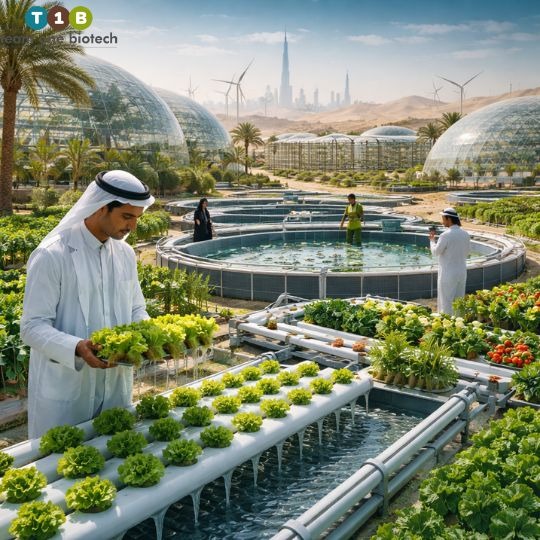
For decades, agriculture worldwide has operated on a simple premise: apply chemicals to force production. Fertilizers to feed plants. Pesticides to kill threats. Antibiotics to suppress disease in fish. This linear, extractive model has devastated ecosystems globally. In the UAE’s fragile desert environment, it accelerates collapse.
Biotech solutions represent a paradigm shift. Instead of overwhelming natural systems with synthetic compounds, bioremediation harnesses living organisms, specific bacterial strains, enzymes, and microbial consortia, to create regenerative cycles. These biological agents don’t just treat symptoms; they fundamentally restore ecological balance.
The Circular Water Economy
Water scarcity defines the UAE’s agricultural reality. The nation has one of the world’s highest per-capita water footprints, yet ranks among the most water-stressed countries globally. In this context, every liter must work harder, cycle longer, and contaminate less.
Probiotic treatments and enzyme-based biotech create closed-loop water systems where beneficial microorganisms continuously purify and regenerate resources. Unlike chemical treatments that leave residues requiring disposal, biological agents break down organic waste, neutralize toxins, and convert pollutants into nutrients. The water improves with each cycle rather than degrading.
This matters acutely in the UAE, where desalination provides much of the fresh water at enormous energy cost. Recirculating aquaculture systems (RAS) and controlled-environment agriculture can reduce water consumption by up to 90% compared to traditional methods, but only if water quality remains stable without constant chemical intervention. Biotech makes this possible.
Soil as Living Infrastructure
Desert soils present a cruel paradox. They often contain mineral nutrients but lack the biological activity to make those nutrients available to plants. High salinity creates osmotic stress that prevents root water uptake. Compaction and lack of organic matter mean water either evaporates instantly or drains away unused.
Chemical fertilizers provide a temporary nutrient surge but acidify soil, kill beneficial organisms, and increase salinity through salt accumulation. Each application leaves soil less productive than before, a downward spiral that has rendered vast agricultural regions worldwide essentially sterile.
Bioremediation rebuilds soil as functional ecosystem. Specific bacterial strains chelate nutrients, making them bioavailable. Mycorrhizal fungi extend root networks, dramatically improving water and nutrient uptake. Enzyme complexes break down salt compounds and organic matter, gradually reducing salinity while building soil structure.
Recent trials in Al Ain demonstrated that biotech-treated soils increased water retention by 40% and reduced irrigation needs by 35% while simultaneously improving crop yields. The soil wasn’t just supporting plants, it was actively becoming more productive with each growing cycle.
Aquaculture Revolution: Building the Protein Pillar
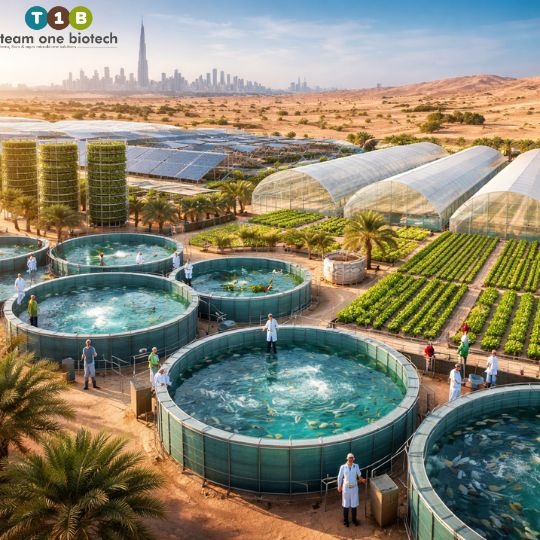
The UAE’s National Food Security Strategy identifies aquaculture as central to achieving protein self-sufficiency. Fish and shrimp farming offer higher feed conversion efficiency and lower carbon footprints than terrestrial livestock. Barramundi, tilapia, and white-leg shrimp (Litopenaeus vannamei) are particularly suited to UAE conditions when raised in properly managed systems.
Yet conventional aquaculture carries substantial risks. Intensive fish farming concentrates waste, depletes oxygen, and creates ideal conditions for pathogenic bacteria. The standard response, antibiotics, creates resistant bacterial strains, leaves residues in seafood, and fails to address underlying water quality issues.
Recirculating Aquaculture Systems: Technology Meets Biology
RAS technology represents the mechanical foundation of modern aquaculture: sophisticated filtration, climate control, and water recycling infrastructure. These systems allow farmers in Abu Dhabi or Sharjah to maintain optimal conditions regardless of external desert extremes.
But mechanical filtration alone cannot manage the complex biochemistry of intensive fish production. Ammonia from fish waste must be converted to less toxic forms. Dissolved organic compounds must be broken down. Pathogenic bacteria must be suppressed without eliminating beneficial microorganisms. The water must remain a living, balanced medium.
This is precisely where biotech applications deliver outsized value.
Probiotic Water Treatment: The Competitive Microbial Advantage
Introducing specific probiotic bacterial strains into RAS creates what microbiologists call “competitive exclusion.” Beneficial bacteria rapidly colonize all available ecological niches, tank surfaces, biofilters, the fish gut microbiome itself. Pathogenic organisms, arriving later and in smaller numbers, find no foothold.
This biological defense operates continuously, 24 hours daily, without creating resistance issues. The probiotics also produce enzymes that break down waste compounds, clarify water, and reduce the organic load on mechanical filtration systems.
Field data from commercial shrimp farms using probiotic protocols show:
- Reduction in disease outbreaks by 60-75%
- Elimination of antibiotic use while maintaining or improving survival rates
- Water quality stabilization with 30-40% less mechanical intervention
- Improved Feed Conversion Ratios (FCR) from 1.8 to 1.4 or better
That FCR improvement is economically transformative. It means producing the same biomass of shrimp with 22% less feed, directly reducing the single largest operating cost while lowering environmental impact.
Enzymatic Solutions: Precision Biochemistry
While probiotics provide broad-spectrum biological management, specific enzymes deliver targeted interventions. Protease enzymes accelerate protein breakdown, preventing toxic ammonia spikes. Amylase enzymes process carbohydrates that would otherwise cloud water and promote harmful bacterial growth. Cellulase enzymes break down plant-based feed components, improving digestibility and reducing waste.
These enzymes don’t persist in the environment or accumulate in fish tissue. They perform their catalytic function and degrade naturally, leaving no residue. This aligns perfectly with export market demands, particularly European and Asian markets where antibiotic residues trigger automatic rejections.
The Business Case: Numbers That Matter
A 500-ton annual production shrimp farm in the UAE using conventional methods faces:
- Feed costs: AED 4.5 million (assuming FCR 1.8, feed price AED 5,000/ton)
- Disease losses: 15-25% biomass
- Antibiotic/chemical treatments: AED 180,000-250,000
- Water/energy for quality management: AED 400,000
The same farm using integrated biotech solutions:
- Feed costs: AED 3.5 million (FCR improvement to 1.4)
- Disease losses: 5-8% biomass
- Biotech treatments: AED 120,000
- Water/energy: AED 280,000 (more stable systems require less intervention)
The operating cost reduction exceeds AED 1.4 million annually while producing higher-quality, export-ready product. Payback on biotech investment occurs within the first production cycle.
For investors evaluating aquaculture opportunities in the UAE, these metrics are decisive. The Ministry of Climate Change and Environment (MOCCAE) increasingly requires sustainable practices for licensing and subsidies. Farms unable to demonstrate chemical reduction and environmental compliance will face regulatory headwinds. Those built on biotech foundations position themselves as preferred partners for government initiatives.
Your aquaculture investment deserves technology that scales with production while reducing risk. Modern biotech solutions eliminate the antibiotic dependency that threatens market access and profitability.
Desert Agriculture: Growing Food Where Nothing Should Grow
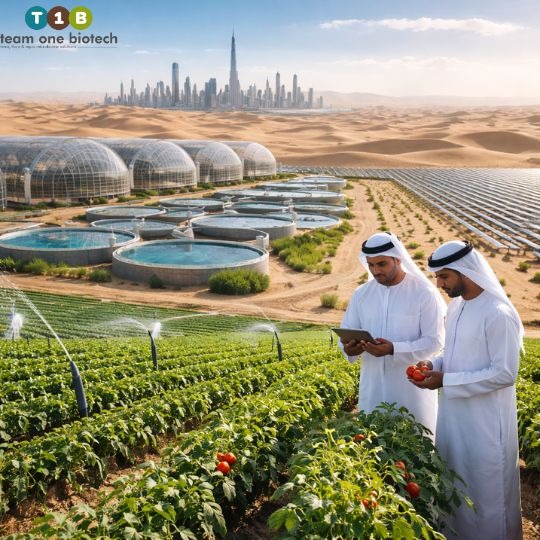
The UAE has committed to increasing local produce availability to meet 30% of domestic demand by 2031. This requires producing vegetables, fruits, and fodder crops in conditions that defy conventional horticultural wisdom.
High-tech controlled environment agriculture (CEA), greenhouses with climate control, hydroponics, vertical farming, provides the physical infrastructure. These facilities dot the landscapes around Al Ain, Fujairah, and Ras Al Khaimah, representing billions in investment. Yet infrastructure alone cannot guarantee success. The growing media, water quality, and plant health management ultimately determine whether these facilities profit or fail.
Saline Soil Rehabilitation: The Foundation Layer
Even in controlled environments, substrate quality matters enormously. Many UAE farms use imported coconut coir or peat, expensive, ecologically questionable materials that must be replaced regularly. Others attempt to use local soils, which typically contain 2,000-8,000 ppm salinity (crops generally tolerate maximum 1,500 ppm).
Biotech soil conditioning offers an alternative pathway. Specific halotolerant bacteria (salt-tolerant microorganisms) colonize the root zone and produce exopolysaccharides that bind sodium ions, effectively sequestering salt away from plant roots. These bacteria also produce growth-promoting hormones (auxins, cytokinins) that help plants resist osmotic stress.
Enzyme treatments complement bacterial action. Cellulase and hemicellulase enzymes break down crop residues and organic amendments, rapidly building soil organic matter. This organic content improves water retention and creates physical structure that reduces compaction and salt concentration around roots.
A farm in the Al Dhafra region applied this combined approach to historically unproductive sandy-saline soil. Within three growing seasons:
- Soil electrical conductivity (EC) dropped from 7.2 dS/m to 3.1 dS/m
- Organic matter increased from 0.4% to 2.8%
- Crop yields (tomatoes, cucumbers, leafy greens) increased 180%
- Irrigation water requirements decreased 40%
The farm transitioned from barely viable to consistently profitable while building an asset, improved soil, that increases in value each season.
Water Efficiency: More Crop Per Drop
The UAE’s water strategy centers on radical efficiency. The phrase “more crop per drop” isn’t marketing language, it’s national policy backed by specific consumption targets and pricing mechanisms that penalize waste.
Biotech enables precision water management in several ways:
Root Zone Optimization: Mycorrhizal fungi form symbiotic relationships with plant roots, extending the effective root system by 100-1000 times through microscopic hyphal networks. These fungi access water and nutrients far beyond the plant’s natural reach, dramatically improving uptake efficiency.
Drought Stress Resistance: Certain bacterial strains produce ACC deaminase, an enzyme that modulates ethylene production in plants. Ethylene triggers stress responses that close stomata and reduce growth. By managing ethylene levels, these bacteria help plants maintain productivity under water stress.
Hydrogel Enhancement: Biotech-derived hydrogels absorb and retain water in root zones, releasing it slowly as plants need it. Unlike synthetic polymers, these biological hydrogels break down into soil nutrients rather than accumulating as microplastic pollution.
Hydroponic and aeroponic systems, common in UAE CEA facilities, benefit dramatically from biotech water treatment. Probiotic additions to nutrient solutions suppress pythium and other root pathogens that thrive in water-based systems. This eliminates the need for fungicides that can accumulate in edible crops and contaminate recycled water.
Pest and Disease Management Without Poisons
Desert agriculture faces unique pest pressures. Whiteflies, aphids, and spider mites thrive in the warm, protected greenhouse environments. Traditional pesticide applications create multiple problems: resistance development, worker exposure risks, residues on produce that fail export testing, and destruction of beneficial insects.
Biological control agents, predatory insects, parasitoid wasps, entomopathogenic fungi, offer an alternative, but these require careful ecosystem management to remain effective. Biotech enhances this approach through:
Induced Systemic Resistance: Certain beneficial bacteria, when colonizing plant roots, trigger the plant’s own immune responses. The plant produces defensive compounds that deter pests and resist disease without external chemical application.
Quorum Sensing Disruption: Pathogenic bacteria coordinate attacks using chemical signaling molecules. Biotech products containing quorum-quenching enzymes interfere with these signals, preventing the synchronized bacterial infections that cause crop losses.
Microbial Biofungicides: Fungal diseases devastate greenhouse crops. Trichoderma and Bacillus species produce antibiotics and compete directly with pathogenic fungi, providing protection without toxic residues.
A major tomato producer in Sharjah implemented fully biological pest and disease management using these biotech tools. Results over two years:
- Pesticide costs decreased from AED 85,000 to AED 12,000 annually
- Crop rejection due to residue testing dropped from 8% to zero
- Overall yields increased 15% due to healthier, unstressed plants
- Export certification to EU markets achieved (previously impossible)
The export access alone transformed the business model, allowing premium pricing that more than justified the biological management investment.
Commercial farms positioned for export markets cannot afford pesticide residue failures. Biotech-based crop protection delivers both food safety compliance and superior yields.
The Investment Landscape: Where Biology Meets ROI
The UAE government actively supports agricultural innovation through multiple channels. MOCCAE coordinates food security initiatives, providing technical guidance and regulatory frameworks. The Abu Dhabi Agriculture and Food Safety Authority (ADAFSA) offers subsidies and support for technology adoption. Dubai’s Food Tech Valley initiative attracts agricultural technology companies and offers infrastructure for pilot projects.
This institutional support creates unusual opportunities for investors willing to deploy capital into biotech-enhanced agriculture. Unlike speculative agtech ventures, biotech solutions for UAE conditions address immediate, proven needs with measurable returns.
Risk Mitigation Through Biology
Traditional agricultural investment carries climate risk (drought, extreme weather), market risk (price volatility), and production risk (disease, pest outbreaks). The UAE’s desert environment amplifies all three.
Biotech substantially reduces production risk. Systems designed around biological stability rather than chemical intervention show markedly lower variance in outcomes. A RAS facility using comprehensive biotech management experiences fewer disease crashes, more consistent growth rates, and more predictable harvest timing.
This production consistency transforms financial modeling. Lenders and equity investors can underwrite projects with greater confidence when biological safeguards replace chemical dependencies that often fail under stress.
Scalability and Technology Transfer
Biotech solutions scale elegantly from demonstration projects to commercial operations. A probiotic protocol proven on a 10-ton shrimp pilot can deploy across a 500-ton facility with minimal modification. Soil conditioning approaches tested on two hectares extend to 200 hectares using the same biological inputs and protocols.
This scalability matters enormously in the UAE context, where government strategy calls for rapid expansion of domestic production capacity. Projects that demonstrate proof-of-concept can attract follow-on investment for geographic expansion, knowing the core technology remains constant.
The knowledge transfer is equally straightforward. Training farm operators to apply biotech solutions typically requires days rather than months. The products themselves, liquid probiotics, enzyme concentrates, microbial inoculants, require no special handling beyond basic temperature protection. This contrasts sharply with chemical management, which demands extensive safety training, specialized storage, and disposal protocols.
Market Access and Premium Positioning
UAE-produced food faces skepticism in some export markets, fairly or not, based on perceptions about desert agriculture viability. Products certified as organic, antibiotic-free, or pesticide-free command immediate credibility and premium pricing.
Biotech enables these certifications. Shrimp raised without antibiotics, vegetables grown without synthetic pesticides, dates and specialty crops cultivated in biologically enhanced soils, these products access premium market tiers globally.
The UAE’s strategic location provides air freight access to high-value markets in Europe, East Asia, and the Indian subcontinent within 8 hours. Fresh, certification-rich produce from biotech-enhanced farms can compete successfully despite higher production costs because product quality and food safety guarantee premium prices.
If your agricultural project requires investor confidence and export market access, biotech certification provides the competitive differentiation that justifies premium positioning.
Regulatory Environment and National Strategy Alignment
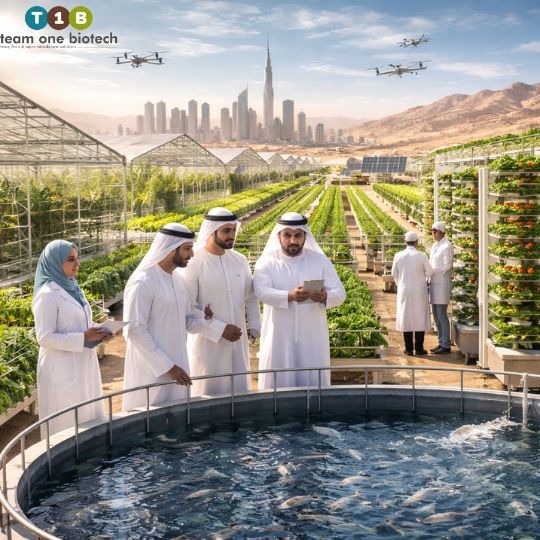
The UAE regulatory framework for agriculture continues evolving rapidly, driven by food security imperatives and environmental commitments. Understanding this landscape is essential for project planning and investment structuring.
MOCCAE Guidelines and Water Conservation Mandates
The Ministry of Climate Change and Environment sets national policy and coordinates implementation across emirates. Recent guidelines emphasize:
- Water use efficiency targets requiring 30% reduction in agricultural water consumption by 2030
- Prohibition of specific chemical pesticides and antibiotics aligned with international standards
- Mandatory environmental impact assessments for new agricultural facilities
- Incentives for adoption of water recycling and biological treatment systems
Biotech solutions directly address these requirements. Projects incorporating biological water treatment, soil conditioning, and chemical reduction receive preferential treatment in licensing, subsidy allocation, and access to government-supported infrastructure.
ADAFSA and Food Safety Standards
The Abu Dhabi Agriculture and Food Safety Authority maintains rigorous standards for food production, particularly for products sold locally or exported under UAE certification. These standards increasingly prohibit antibiotic residues in fish and shrimp, restrict pesticide residues below EU maximum residue limits (MRLs), and require traceability throughout production chains.
Facilities built on biotech foundations can achieve compliance more readily than those retrofitting chemical-dependent operations. Regulatory inspections favor operations demonstrating preventive biological management over reactive chemical treatments.
Dubai and Northern Emirates Initiatives
Dubai’s Food Security Council coordinates private sector engagement, offering partnerships for technology demonstration and market access support. The Northern Emirates, Sharjah, Ajman, Umm Al Quwain, Ras Al Khaimah, and Fujairah, have developed specialized agricultural zones with infrastructure support and streamlined permitting for innovative projects.
These zones actively recruit biotech-forward operations, recognizing that sustainable practices enhance regional reputation and create export opportunities that benefit all stakeholders.
Looking Forward: 2031 and Beyond
The National Food Security Strategy 2031 sets ambitious targets that seemed nearly impossible when announced. Achieving 30% food self-sufficiency in one of the world’s most inhospitable agricultural environments demands technologies that simply didn’t exist a generation ago.
Biotech makes the impossible achievable. Not through dramatic, singular breakthroughs, but through systematic application of biological intelligence to every aspect of desert food production. Water that regenerates rather than degrades. Soil that builds fertility instead of accumulating toxins. Fish and crops that thrive without chemical crutches.
The transition from chemical dependence to biological management isn’t merely environmentally virtuous, it’s economically superior and strategically essential. Every farm that adopts biotech principles reduces import dependency, creates jobs, builds technical expertise, and demonstrates that the UAE can indeed feed itself.
For commercial operators, the choice is increasingly clear. Biotech-enhanced systems cost less to operate, produce higher quality output, meet regulatory requirements more easily, and access premium markets that reject chemical-intensive production. The investment returns are measurable and repeatable.
For the nation, each biotech adoption moves closer to food sovereignty, the ability to feed the population from domestic resources even under global disruption. In an era of climate instability and geopolitical volatility, this sovereignty carries value beyond any financial calculation.
The desert is no longer a barrier to agricultural success. With biotech, it becomes an advantage, an environment so challenging that solutions developed here can deploy successfully anywhere on Earth. The UAE isn’t just securing its own food future; it’s creating exportable technology and expertise that will feed the world’s most stressed regions.
Your operation can lead this transformation or follow it. The economic and strategic advantages of early adoption compound with every growing cycle.
Streamlining Your Supply Chain: Direct Access to Proven Solutions
Implementing biotech solutions at commercial scale requires reliable access to proven products, technical support, and consistent supply logistics. Team One Biotech addresses this requirement through its Official Alibaba Store, a global procurement platform designed specifically for commercial agricultural operations, aquaculture facilities, and institutional buyers.
Why Direct B2B Procurement Matters
Agricultural biotech differs fundamentally from consumer products. Effective implementation requires:
- Product specifications matched precisely to application (water salinity, temperature ranges, target species)
- Batch consistency ensuring reliable performance across production cycles
- Technical documentation including protocols, dosing guidelines, and compatibility data
- Access to application support for troubleshooting and optimization
Product Categories Available
The store organizes solutions by application:
Aquaculture Systems: Probiotics for RAS and biofloc systems, enzymatic water conditioners, organic waste decomposers, pathogen control agents formulated for shrimp, barramundi, tilapia, and marine species.
Soil Health and Conditioning: Halotolerant bacterial consortia for saline soil remediation, mycorrhizal inoculants, enzyme complexes for organic matter development, biostimulants for drought stress tolerance.
Water Treatment and Efficiency: Biological water purification systems, nutrient recycling enhancers, biofilm control agents, irrigation system maintainers.
Crop Protection: Biofungicides, beneficial insect support products, induced resistance elicitors, organic certification-compatible solutions.
Each product listing includes application rates, compatibility information, storage requirements, and expected results under UAE conditions. Technical support teams assist with system design and integration planning.
Procurement Advantages for UAE Operators
Direct manufacturer access eliminates distributor markups while ensuring authentic products. Alibaba’s trade assurance protects commercial purchases with payment security and delivery guarantees. Bulk ordering options reduce per-unit costs and ensure uninterrupted supply for ongoing operations.
The platform facilitates long-term supply agreements essential for operational planning. Facilities can establish reliable procurement relationships that support expansion, replication, and franchising of successful biotech protocols.
For investors conducting due diligence on agricultural projects, direct supplier relationships via established platforms demonstrate operational sophistication and supply chain security. Projects with verified procurement sources and technical support agreements present lower risk profiles than those dependent on gray market or unverifiable product sources.
The T1B Official Alibaba Store provides these elements through a purpose-built commercial platform. Verified supplier status ensures product authenticity. Detailed technical datasheets allow informed selection. Quantity pricing supports operational scaling. Logistics support handles customs, freight, and delivery to UAE facilities.
Visit the T1B Official Alibaba Store to access commercial-grade biotech solutions with the procurement security your operation requires. Transform supply chain risk into competitive advantage through direct manufacturer relationships.
The path to UAE food sovereignty runs directly through biological innovation. Every farm that trades chemical dependence for biotech resilience strengthens national security while building profitable, sustainable enterprise. The technology exists. The regulatory environment supports adoption. The economic case is proven.
The question is no longer whether biotech can deliver desert food production at scale, operations across the UAE demonstrate this daily. The question is how rapidly commercial operators will recognize the strategic and financial advantages of leading this transformation rather than following it.
Your move determines whether your operation becomes a case study in successful innovation or a cautionary tale of competitive disadvantage. Choose biology. Choose sovereignty. Choose the future that’s already working.
Looking to improve your ETP/STP efficiency with the right bioculture?
Talk to our experts at Team One Biotech for customised microbial solutions.
Contact: +91 8855050575
Email: sales@teamonebiotech.com
Visit: www.teamonebiotech.com
Discover More on YouTube – Watch our latest insights & innovations!-
Connect with Us on LinkedIn – Stay updated with expert content & trends!